Chinese Idioms Dictionary Online Free: 100+ Chengyu With Meanings and Examples
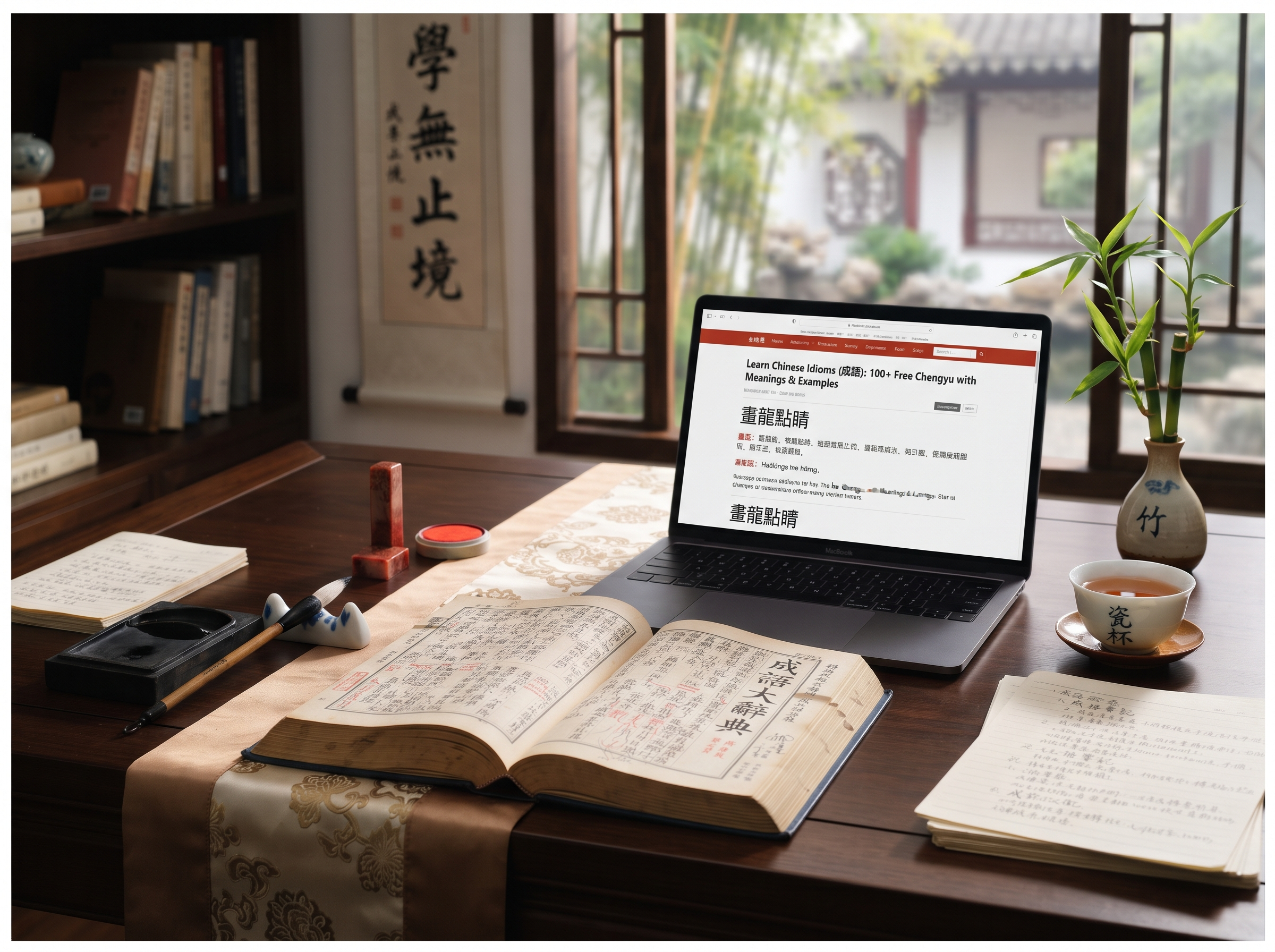
A Chinese idioms dictionary online free can be a useful resource for students, teachers, translators, and anyone learning Mandarin Chinese. Chinese has thousands of traditional expressions, but one of the most recognizable types is 成语 (chéngyǔ), commonly translated as “Chinese idioms.”
Many Chengyu consist of four Chinese characters and express a complete idea, lesson, description, or piece of traditional wisdom. Their meanings are often figurative, so translating each character separately may not explain the actual meaning of the expression.
For example, 画蛇添足 (huà shé tiān zú) literally means “draw a snake and add feet,” but its figurative meaning is to spoil something by doing something unnecessary. Understanding both the literal image and the figurative meaning makes Chinese idioms easier to remember.
What Is a Chinese Idiom?
A Chinese idiom is a fixed or established expression with a conventional meaning. 成语 (chéngyǔ) are particularly important in written Chinese and are also used in speech, education, literature, journalism, and everyday communication.
Many Chengyu are four characters long, although not every Chinese idiomatic expression follows that pattern. Some expressions come from historical stories, classical literature, philosophy, folklore, or traditional sayings.

For English learners, a good Chinese idiom dictionary should ideally provide several pieces of information:
- Chinese characters
- Pinyin pronunciation
- English meaning
- Literal meaning when helpful
- Example sentence
- Background or origin
- Usage information
These details help learners understand not only what an idiom means but also when it sounds natural to use.
Studying or Studing: https://learnidioms.com/studying-or-studing/
Chinese Idioms Dictionary Online Free
The following expressions are useful examples of common Chinese Chengyu. The English explanations focus on the modern meaning rather than translating every character literally.
| Chinese Idiom | Pinyin | English Meaning |
|---|---|---|
| 一举两得 | yī jǔ liǎng dé | Kill two birds with one stone |
| 画蛇添足 | huà shé tiān zú | Do something unnecessary and spoil it |
| 守株待兔 | shǒu zhū dài tù | Wait passively for luck |
| 对牛弹琴 | duì niú tán qín | Speak to someone who cannot appreciate the subject |
| 自相矛盾 | zì xiāng máo dùn | Contradict oneself |
| 半途而废 | bàn tú ér fèi | Give up halfway |
| 入乡随俗 | rù xiāng suí sú | Follow local customs |
| 井井有条 | jǐng jǐng yǒu tiáo | Be orderly and organized |
| 走马观花 | zǒu mǎ guān huā | Look at something superficially |
| 亡羊补牢 | wáng yáng bǔ láo | Take corrective action after a problem |
| 画龙点睛 | huà lóng diǎn jīng | Add the finishing touch |
| 滥竽充数 | làn yú chōng shù | Pretend to be competent |
| 狐假虎威 | hú jiǎ hǔ wēi | Use someone else’s power to intimidate others |
| 掩耳盗铃 | yǎn ěr dào líng | Deceive oneself |
| 刻舟求剑 | kè zhōu qiú jiàn | Follow an outdated method despite changed circumstances |
Common Chinese Idioms With English Meanings
一举两得
Pinyin: yī jǔ liǎng dé
Meaning: To achieve two goals with one action.
Example: 学习中文可以一举两得,既能学习语言,也能了解中国文化。
English: Learning Chinese can achieve two goals at once because you learn the language while also learning about Chinese culture.
The closest common English expression is “kill two birds with one stone.”
画蛇添足
Pinyin: huà shé tiān zú
Meaning: To do something unnecessary that makes a situation worse.
Example: 你的解释已经很清楚了,再加这些细节反而画蛇添足。
English: Your explanation is already clear. Adding those details would only make it worse.
守株待兔
Pinyin: shǒu zhū dài tù
Meaning: To wait passively for an opportunity instead of taking action.
Example: 想找到好工作不能守株待兔,要主动寻找机会。
English: You cannot just wait for a good job to come to you. You need to actively look for opportunities.
对牛弹琴
Pinyin: duì niú tán qín
Meaning: To explain something to someone who cannot understand or appreciate it.
Example: 跟完全不感兴趣的人谈这个问题,就像对牛弹琴。
English: Talking about this subject with someone who has no interest in it is like speaking to someone who cannot appreciate it.
自相矛盾
Pinyin: zì xiāng máo dùn
Meaning: To contradict oneself.
Example: 他说自己从来不迟到,可是昨天又迟到了,真是自相矛盾。
English: He says he is never late, but he was late yesterday. He is contradicting himself.

Chinese Idioms With Pinyin
Pinyin is especially helpful for beginners because Chinese characters do not directly show English speakers how to pronounce a word.
For example:
井井有条
Pinyin: jǐng jǐng yǒu tiáo
Meaning: Well organized and orderly.
Learning an idiom with its pinyin can help students connect the written characters with pronunciation. Tone marks are also important because Mandarin uses tones to distinguish words.
A useful study format is:
Chinese: 半途而废
Pinyin: bàn tú ér fèi
Meaning: To give up halfway
Example: 做事情不能半途而废。
English: You should not give up halfway when doing something.
Studying characters, pronunciation, meaning, and an example together is generally more useful than memorizing an English translation alone.
Simular or Similar: https://learnidioms.com/simular-or-similar/
Chinese Idioms About Life and Wisdom
Many Chengyu communicate ideas about behavior, patience, learning, effort, and decision-making.
亡羊补牢
Pinyin: wáng yáng bǔ láo
Meaning: It is not too late to correct a mistake after a problem has occurred.
Example: 虽然我们犯了错误,但现在改正还不晚,亡羊补牢。
半途而废
Pinyin: bàn tú ér fèi
Meaning: To give up before completing something.
Example: 学习一门语言需要坚持,不能半途而废。
入乡随俗
Pinyin: rù xiāng suí sú
Meaning: Follow the customs of the place you are visiting.
Example: 到不同的国家旅行时,我们应该入乡随俗。
走马观花
Pinyin: zǒu mǎ guān huā
Meaning: To look at something quickly and superficially.
Example: 如果只是走马观花地参观博物馆,很难真正了解这些展品。

Chinese Idioms About People and Relationships
Chinese idioms are also useful when describing people’s behavior and relationships.
狐假虎威
Pinyin: hú jiǎ hǔ wēi
Meaning: To use another person’s authority or influence to intimidate others.
Example: 他只是借老板的权力狐假虎威。
English: He is simply using the boss’s authority to intimidate others.
对牛弹琴
This expression can describe communication that is ineffective because the listener does not understand or appreciate what is being discussed.
It should be used carefully because calling someone a “cow” metaphorically can sound insulting.
自相矛盾
This idiom is useful when someone’s statements or actions contradict each other.
Example: 他说的话前后自相矛盾。
English: His statements contradict each other.

Chinese Idioms About Success and Failure
Many Chengyu describe effort, mistakes, persistence, and achievement.
一举两得
This expression describes accomplishing two things with one action.
画龙点睛
Pinyin: huà lóng diǎn jīng
Meaning: To add the crucial finishing touch that makes something complete or effective.
Example: 最后一句话起到了画龙点睛的作用。
English: The final sentence provided the finishing touch.
半途而废
This expression describes giving up before reaching a goal.
It can be used when talking about studying, work, exercise, projects, or other activities that require persistence.
How to Learn Chinese Idioms
Learning Chengyu becomes easier when you study them in context rather than memorizing long lists.
Learn the Characters
Start with the Chinese characters and their pronunciation. Recognizing the characters helps you identify the idiom when reading Chinese.
Learn the Pinyin
Write down the pinyin with tone marks. This gives you a pronunciation reference when speaking.
Understand the Figurative Meaning
Do not rely only on a literal translation. Ask what idea the complete expression communicates.
For example:
守株待兔
Literal image: waiting beside a tree stump for a rabbit.
Figurative meaning: waiting passively for something good to happen instead of taking action.
Study an Example Sentence
An example shows how the idiom works in real language.
Instead of memorizing:
亡羊补牢 = fix a problem
learn it in a sentence:
现在改正还不晚,亡羊补牢。
This provides context and makes the expression easier to remember.
Learn the Story When Relevant
Many traditional Chengyu have interesting origins. Understanding the story behind an expression can make its meaning easier to remember and can also provide cultural context.
Common Mistakes When Learning Chinese Idioms
One common mistake is translating every character literally and assuming that the resulting sentence is the meaning. Chinese idioms often have figurative meanings that must be learned as complete expressions.
Another mistake is using an idiom simply because its English translation seems appropriate. An expression may be grammatically possible but still sound unnatural in a particular context.
Pronunciation is another important area. Learners should pay attention to Mandarin tones instead of memorizing only the English meaning.
It is also useful to learn whether an expression is common in modern communication, literary, formal, humorous, or historical contexts. Not every traditional Chengyu should be used in every everyday conversation.
Why Use a Chinese Idioms Dictionary?
A Chinese idioms dictionary can bring several pieces of information together in one place. Instead of searching separately for characters, pronunciation, translation, and examples, learners can study the expression as a complete unit.
For students, this can make vocabulary study more organized. Teachers can use idioms to introduce Chinese culture and figurative language. Translators can use them to understand the meaning and context before choosing an appropriate English equivalent.
For independent learners, keeping a personal list of idioms with characters, pinyin, meanings, and example sentences can provide a practical vocabulary resource.

FAQs:
Conclusion
Chinese idioms are an important part of the language and culture. 成语 (chéngyǔ) often contain only a few characters but can communicate complex ideas about human behavior, relationships, decisions, success, mistakes, and life.
Expressions such as 一举两得, 画蛇添足, 守株待兔, 入乡随俗, and 亡羊补牢 are useful examples of how a short Chinese expression can carry a much deeper meaning.