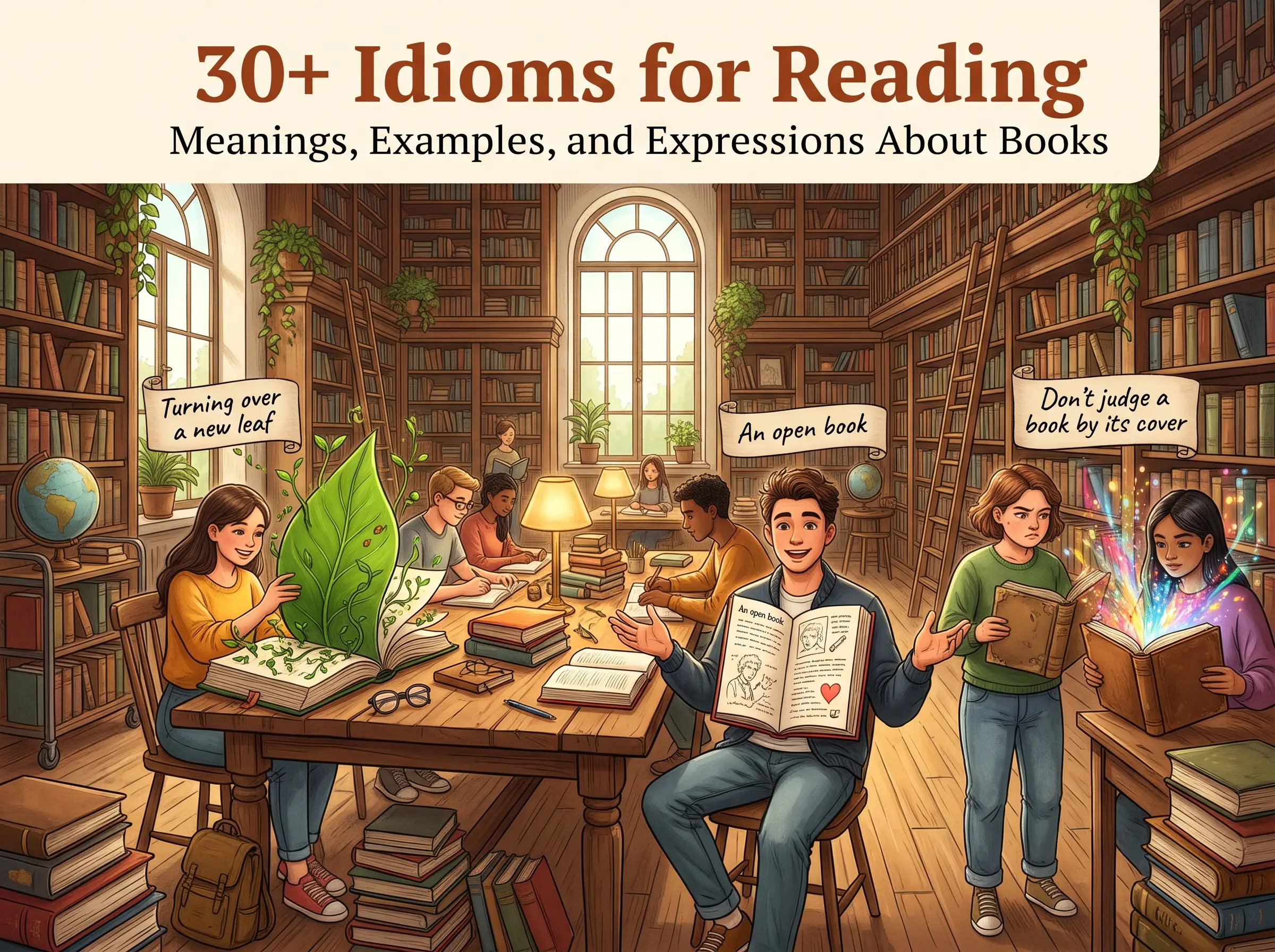
30+ Idioms for Reading: Meanings, Examples, and Expressions About Books
Reading is an important part of learning, communication, and everyday life. English speakers also use many expressions related to books, pages, stories, and written words to describe knowledge, understanding, curiosity, and personal experiences. These expressions are known as reading idioms.
Idioms for reading are useful for students, teachers, book lovers, and English learners who want to improve their vocabulary. Expressions such as “read between the lines,” “turn over a new leaf,” and “judge a book by its cover” appear in everyday conversations, classrooms, workplaces, and informal writing.
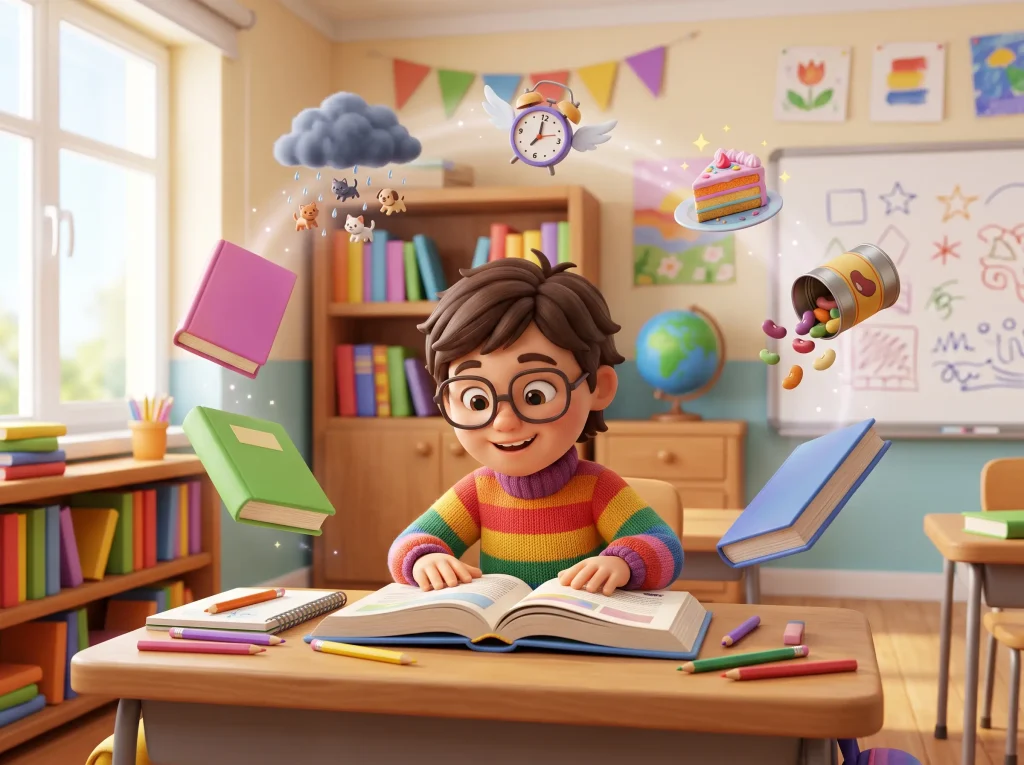
In this article, you will learn more than 30 reading-related idioms, including their meanings and practical example sentences. You will also understand how to use these expressions naturally in American English.
What Are Idioms for Reading?
Idioms for reading are figurative expressions connected to books, reading, writing, stories, pages, and understanding information. Their meanings often go beyond the literal definitions of their individual words.
For example, “read between the lines” does not mean reading the empty spaces between written sentences. It means understanding a hidden message or meaning that someone has not expressed directly.
Similarly, “don’t judge a book by its cover” teaches people not to form opinions about someone or something based only on appearance.
Reading-related idioms can help you:
- Improve your English vocabulary and comprehension.
- Understand expressions used in books, articles, and conversations.
- Communicate ideas more naturally.
- Describe learning, intelligence, and personal growth.
- Understand figurative language in literature and everyday speech.
Some expressions are specifically about books and reading, while others use reading-related words to communicate broader ideas.
Common Idioms for Reading and Their Meanings
These expressions are useful when talking about reading habits, books, information, and understanding written or spoken messages.
1. Read Between the Lines
Meaning: Understand a hidden meaning or message that is not directly stated.
Example: When my manager said we should prepare for changes, I read between the lines and realized that some jobs might be affected.
2. Judge a Book by Its Cover
Meaning: Form an opinion about someone or something based only on appearance.
Example: The small bookstore looked ordinary, but it had an amazing collection. Never judge a book by its cover.
3. Turn Over a New Leaf
Meaning: Make a fresh start or change your behavior for the better.
Example: After failing his exams, Daniel decided to turn over a new leaf and study every evening.
4. Hit the Books
Meaning: Begin studying seriously.
Example: I have a biology exam tomorrow, so I need to hit the books tonight.
5. Bookworm
Meaning: A person who loves reading books and spends a lot of time doing it.
Example: My sister is a bookworm who reads two novels every month.
6. An Open Book
Meaning: Someone whose thoughts, feelings, or personality are easy to understand.
Example: Sarah is an open book, so you always know what she is thinking.
7. By the Book
Meaning: Follow rules, instructions, or procedures exactly.
Example: Our new teacher does everything by the book.
8. In Black and White
Meaning: Written or printed clearly, especially as official information or proof.
Example: The agreement is in black and white, so nobody can deny what was promised.
9. One for the Books
Meaning: An unusual, impressive, or memorable event.
Example: Winning three games in one day was certainly one for the books.
10. Don’t Judge a Book by Its Cover
Meaning: Do not decide whether someone or something is good or bad based only on appearance.
Example: He may seem quiet, but he is an excellent speaker. Don’t judge a book by its cover.
11. Close the Book on Something
Meaning: Bring an experience, situation, or period of activity to an end.
Example: After years of disagreements, the two companies finally closed the book on their legal dispute.
12. Read Someone Like a Book
Meaning: Understand someone’s thoughts, feelings, or intentions very easily.
Example: My mother can read me like a book whenever I try to hide something.
13. Write Your Own Story
Meaning: Take control of your life and make your own decisions.
Example: You don’t have to follow everyone else’s expectations. You can write your own story.
14. Turn the Page
Meaning: Move on from a difficult experience and begin a new chapter in life.
Example: After leaving her old job, she was ready to turn the page and start again.
15. Read Up on Something
Meaning: Study or gather information about a particular subject.
Example: Before buying a new laptop, I read up on different models and their features.
Idioms About Books, Stories, and Pages
Books and stories provide many expressions for describing experiences, decisions, and different stages of life. These idioms are especially useful when discussing personal development, relationships, and memorable events.

16. Every Book Has Its Own Story
Meaning: Every person or situation has a unique background or history.
Example: Don’t make assumptions about strangers because every book has its own story.
17. A Chapter of Your Life
Meaning: A particular period or stage in someone’s life.
Example: Moving to California was an exciting chapter of my life.
18. A Closed Book
Meaning: A subject or person that is difficult to understand or know about.
Example: Advanced mathematics is a closed book to me.
19. Open a New Chapter
Meaning: Begin a new stage or period in life.
Example: Graduating from college allowed her to open a new chapter in her career.
20. The Last Chapter
Meaning: The final stage of an experience, activity, or period.
Example: His retirement marked the last chapter of his professional career.
21. Read the Fine Print
Meaning: Carefully examine the small or less noticeable details in a document or agreement.
Example: Always read the fine print before signing a credit card agreement.
22. A Page-Turner
Meaning: An exciting or interesting book that makes readers want to continue reading.
Example: The mystery novel was such a page-turner that I finished it in one weekend.
23. Write Something Off
Meaning: Decide that something is not worth considering, pursuing, or expecting to succeed.
Example: Don’t write off the new student just because he is quiet.
24. Write Something in Stone
Meaning: Make a decision or plan that cannot easily be changed.
Example: Our vacation dates are not written in stone, so we can still adjust them.

Idioms About Learning and Knowledge
Reading is closely connected to education and acquiring knowledge. These expressions are helpful when discussing school, studying, professional development, and intellectual growth.
25. Learn Something by Heart
Meaning: Memorize something completely.
Example: The students learned the poem by heart before the competition.
26. Know Something Like the Back of Your Hand
Meaning: Know something extremely well.
Example: My English teacher knows grammar like the back of her hand.
27. Get the Hang of Something
Meaning: Learn how to do something after practicing it.
Example: It took me a few days to get the hang of reading English novels.
28. Brush Up on Something
Meaning: Improve knowledge or skills that you have not used recently.
Example: I need to brush up on my grammar before taking the English test.
29. Food for Thought
Meaning: An idea or piece of information that makes someone think carefully.
Example: The article about online education gave me plenty of food for thought.
30. Know Your ABCs
Meaning: Understand the basic principles of a subject.
Example: Before learning advanced programming, you should know your ABCs.
31. Put Something in Writing
Meaning: Record information, an agreement, or a decision in written form.
Example: The manager asked us to put the new workplace rules in writing.
32. Learn the Ropes
Meaning: Learn how to do a job or activity.
Example: It took me a month to learn the ropes at my new job.
33. Take a Leaf Out of Someone’s Book
Meaning: Copy or follow someone’s successful behavior or example.
Example: You should take a leaf out of your brother’s book and develop a regular study routine.
Idioms About Understanding and Interpretation
Some reading-related expressions describe how people interpret information, recognize hidden meanings, or understand complicated situations.
34. Take Something at Face Value
Meaning: Accept something as it appears without looking for a deeper meaning.
Example: Don’t take every advertisement at face value. Check the details before making a purchase.
35. Get the Picture
Meaning: Understand a situation or explanation.
Example: After reviewing the instructions, I finally got the picture.
36. See the Big Picture
Meaning: Understand the overall situation instead of focusing only on small details.
Example: A good manager needs to see the big picture before making important decisions.
37. Put Two and Two Together
Meaning: Use available information to reach a logical conclusion.
Example: When I noticed the missing keys and the open garage door, I put two and two together.
38. Spell It Out
Meaning: Explain something clearly and in detail so that nobody misunderstands it.
Example: The teacher had to spell out the assignment requirements for the students.
39. Read the Room
Meaning: Understand people’s feelings and reactions in a particular situation.
Example: Before making jokes during the serious meeting, learn to read the room.
40. Take a Page Out of Someone’s Book
Meaning: Follow someone’s example or adopt a useful approach they use.
Example: I decided to take a page out of my friend’s book and organize my daily schedule.

Funny and Informal Reading Expressions
Some expressions connected to reading and books are humorous or conversational. They can make everyday English sound more natural when used in the right context.
| Expression | Meaning | Example |
|---|---|---|
| Book smart | Having strong academic or theoretical knowledge | She is book smart but needs more practical experience. |
| Street smart | Having practical knowledge about everyday situations | Growing up in a busy city made him street smart. |
| Crack open a book | Start reading or studying a book | I need to crack open a book before the exam. |
| Read someone the riot act | Scold someone severely for bad behavior | The coach read the players the riot act after their poor performance. |
| An open-and-shut case | A situation that is easy to understand or decide | The evidence made it an open-and-shut case. |
| By the same token | For the same reason or in the same way | Reading improves vocabulary, and by the same token, writing helps strengthen language skills. |
These expressions can help learners discuss books, education, and everyday experiences without relying on basic vocabulary alone.
How to Use Reading Idioms in Everyday English
Reading idioms can make conversations more expressive, especially when discussing books, school, work, and personal experiences.
Here are a few practical tips:
- Understand the context: Learn when an expression is appropriate before using it.
- Practice with sentences: Create examples related to your daily life.
- Read English books: Pay attention to how authors use figurative expressions.
- Listen to conversations: Notice idioms in movies, interviews, podcasts, and everyday discussions.
- Avoid overusing them: One or two suitable idioms can make a conversation more natural.
For example, instead of saying, “I need to study hard tonight,” you can say, “I need to hit the books tonight.”
Instead of saying, “I understand what you are suggesting without you saying it directly,” you can use “I can read between the lines.”

Common Mistakes When Using Reading Idioms
English learners sometimes confuse reading idioms with their literal meanings or use expressions in situations where they do not fit.
Here are some mistakes to avoid:
| Common mistake | Correct usage |
|---|---|
| Using “hit the books” to mean physically hitting books | Use it to describe studying seriously. |
| Thinking “read between the lines” means reading extra text | Use it to describe understanding an implied message. |
| Calling every person who reads a book a bookworm | A bookworm usually loves reading and reads frequently. |
| Using “by the book” to describe creative freedom | Use it when someone follows established rules. |
| Confusing “an open book” with an actual book | Use it to describe someone who is easy to understand. |
| Using “turn over a new leaf” for turning a physical page | Use it when someone makes a fresh start. |
Remember that idioms should be understood as complete expressions. Their intended meanings are often different from the meanings of individual words.
Frequently Asked Questions:
Conclusion
Idioms for reading help English learners understand how books, pages, and written words are used to express broader ideas. Expressions such as “read between the lines,” “hit the books,” “bookworm,” and “turn over a new leaf” are useful in everyday American English.
Learning these expressions can improve your vocabulary, reading comprehension, and communication skills. Practice them through books, conversations, and example sentences to become more comfortable using figurative English.