Music Phrases and Idioms: 50 Common Expressions With Meanings and Examples
Music is part of everyday life, and its vocabulary has found a lasting place in the English language. People talk about hitting the right note, facing the music, changing their tune, and marching to the beat of their own drum, even when they are not discussing songs or musical performances.
Music phrases and idioms are expressions inspired by music, instruments, singing, rhythm, and sound. Many have figurative meanings that go beyond their literal words. Learning these expressions can help English learners understand conversations, recognize figurative language, and communicate more naturally in American English.
Some expressions are familiar idioms, while others are common sayings or figurative phrases. The examples below explain how they work in everyday situations, from school and friendships to work, decision-making, and personal experiences.
Eat Idioms: https://learnidioms.com/120-eat-idioms/
What Are Music Phrases and Idioms?
Music idioms are established expressions that use musical words to communicate a meaning beyond their literal interpretation. For example, “face the music” means to accept the consequences of your actions, while “music to my ears” describes news that is especially welcome or pleasing.

Music-related phrases can also include metaphors, sayings, and expressions that are not strictly idioms. For instance, “hit the right note” uses musical language figuratively to describe doing or saying something appropriate for a particular situation.
Understanding the difference helps learners use expressions accurately. The key is to learn not only the definition but also the context, tone, and grammatical pattern in which each phrase normally appears.
Wolf Idioms: https://learnidioms.com/wolf-idioms/
50 Music Phrases and Idioms With Meanings and Examples
Idioms About Success, Effort, and Opportunity
These expressions describe achievement, progress, responsibility, and the ability to respond to changing situations.
1. Face the music
Meaning: Accept criticism, punishment, or the consequences of your actions.
Example: “After missing the deadline, Jake had to face the music and explain what happened to his manager.”
2. Play it by ear
Meaning: Decide what to do as a situation develops instead of following a fixed plan.
Example: “We haven’t decided where to eat tonight, so let’s play it by ear.”
3. Pull out all the stops
Meaning: Make the greatest possible effort to achieve something.
Example: “The school pulled out all the stops to make the graduation ceremony special.”
4. Hit the right note
Meaning: Say or do something that is appropriate or well received.
Example: “Her opening remarks hit the right note with the audience.”
5. Call the tune
Meaning: Be the person who controls a situation or makes the decisions.
Example: “The project director calls the tune when it comes to the team’s schedule.”
6. Play second fiddle
Meaning: Have a less important or subordinate role than someone else.
Example: “Maya was tired of playing second fiddle to her more experienced coworkers.”
7. For a song
Meaning: At a very low price or much less than something is worth.
Example: “I bought a nearly new desk for a song at the neighborhood yard sale.”
8. It ain’t over till the fat lady sings
Meaning: A situation is not finished, and the outcome can still change.
Example: “Our team is behind by ten points, but it ain’t over till the fat lady sings.”
This is a traditional saying, often expressed more neutrally as “It’s not over until it’s over.”
9. March to the beat of your own drum
Meaning: Act independently instead of following what everyone else does.
Example: “He marches to the beat of his own drum and chooses projects that interest him.”
10. Blow your own horn
Meaning: Talk proudly about your own achievements or abilities.
Example: “I don’t mean to blow my own horn, but I finished the entire project ahead of schedule.”

Idioms About Emotions, Relationships, and Reactions
Musical expressions are useful for describing strong feelings, personal connections, disagreements, and changing attitudes.
11. Music to someone’s ears
Meaning: News or information that someone is very pleased to hear.
Example: “Hearing that the company approved my vacation request was music to my ears.”
12. Strike a chord
Meaning: Create a strong feeling of recognition, sympathy, or emotional connection.
Example: “The speaker’s story about moving to a new city struck a chord with many students.”
13. Change your tune
Meaning: Change your opinion, attitude, or behavior.
Example: “He changed his tune after learning how much the repairs would cost.”
14. Sing someone’s praises
Meaning: Speak enthusiastically about someone’s qualities or achievements.
Example: “The coach sang the young player’s praises after the championship game.”
15. Ring a bell
Meaning: Sound familiar, even if you cannot remember the details.
Example: “That author’s name rings a bell, but I can’t remember which book she wrote.”
16. As fit as a fiddle
Meaning: Very healthy and physically fit.
Example: “My grandfather is eighty years old and still as fit as a fiddle.”
17. Face the music together
Meaning: Deal with an unpleasant consequence or difficult situation as a group.
Example: “We made the mistake as a team, so we’ll face the music together.”
18. Sing a different tune
Meaning: Change one’s opinion or attitude, often after circumstances change.
Example: “She was against the plan at first, but she sang a different tune after seeing the results.”
19. Play to the gallery
Meaning: Try to win the approval of an audience, sometimes by doing something dramatic or showy.
Example: “The politician’s exaggerated gestures seemed designed to play to the gallery.”
20. Make a song and dance about something
Meaning: Make an excessive fuss about something.
Example: “Don’t make a song and dance about a small scheduling mistake.”

Idioms About Communication, Agreement, and Understanding
These phrases help describe how people communicate, cooperate, express opinions, and respond to one another.
21. Blow the whistle
Meaning: Report wrongdoing or bring attention to something improper.
Example: “An employee blew the whistle on the company’s unsafe working practices.”
22. Be in tune with someone
Meaning: Understand or share another person’s feelings, ideas, or needs.
Example: “A good teacher stays in tune with the needs of the students.”
23. Be out of tune with something
Meaning: Be inconsistent with, or not suited to, a particular situation, feeling, or set of ideas.
Example: “His rude comments were out of tune with the friendly atmosphere of the meeting.”
24. Sing from the same hymn sheet
Meaning: Share the same understanding or present a consistent message.
Example: “Before meeting the client, the team made sure everyone was singing from the same hymn sheet.”
This expression is more common in British English; American speakers may say “be on the same page.”
25. Play by ear
Meaning: Perform music without relying on written notation; by extension, respond intuitively rather than following a fixed plan.
Example: “She learned to play the melody by ear after hearing it a few times.”
26. Sound like a broken record
Meaning: Repeat the same thing so often that it becomes annoying or predictable.
Example: “I know I sound like a broken record, but please remember to submit your timesheet.”
27. Blow your own trumpet
Meaning: Boast about your achievements or abilities.
Example: “He never misses an opportunity to blow his own trumpet during meetings.”
This wording is especially familiar in British English. “Blow your own horn” is a common American equivalent.
28. Beat the drum for something
Meaning: Promote or support an idea, cause, or person enthusiastically.
Example: “The organization continues to beat the drum for better public libraries.”
29. Dance to someone’s tune
Meaning: Do what another person wants, often because they have power or influence over you.
Example: “She refused to dance to her competitor’s tune and continued with her own business plan.”
30. It takes two to tango
Meaning: Two people are usually responsible for a situation involving both of them.
Example: “They both contributed to the argument. It takes two to tango.”

Idioms About Problems, Change, and Everyday Situations
These expressions describe unexpected events, difficult circumstances, decisions, and the way people respond to change.
31. All that jazz
Meaning: Other similar things or related details, often mentioned casually.
Example: “Bring your notebook, pens, laptop, and all that jazz.”
32. Fiddle while Rome burns
Meaning: Spend time on unimportant matters while a serious problem needs attention.
Example: “The department kept arguing about decorations while the project deadline approached. They were fiddling while Rome burned.”
33. Whistle in the dark
Meaning: Pretend to be confident or unafraid when feeling worried or uncertain.
Example: “He joked about the difficult exam, but I think he was whistling in the dark.”
34. Whistle a different tune
Meaning: Change one’s attitude or opinion, usually because circumstances have changed.
Example: “They whistled a different tune when they realized the project was more expensive than expected.”
35. Change the record
Meaning: Stop repeating the same complaint or subject.
Example: “You’ve complained about the weather all morning. Can we change the record?”
36. Blow a fuse
Meaning: Become suddenly and extremely angry.
Example: “Dad blew a fuse when he discovered that someone had scratched the car.”
37. Jam session
Meaning: An informal musical gathering where musicians improvise together; sometimes used figuratively for a relaxed collaborative session.
Example: “The musicians held a jam session in the garage on Saturday.”
38. A one-hit wonder
Meaning: A performer or group known mainly for one successful song or achievement.
Example: “The band became a one-hit wonder after its first single topped the charts.”
39. Set the tone
Meaning: Establish the mood, style, or character of a situation.
Example: “The principal’s welcoming speech set the tone for the school year.”
40. End on a high note
Meaning: Finish an activity or experience successfully or positively.
Example: “The team won its final game and ended the season on a high note.”

Idioms About Music, Performance, and Rhythm
These expressions draw more directly on instruments, singing, musical ability, and performance.
41. As clean as a whistle
Meaning: Completely clean; it can also describe someone who is honest or free from wrongdoing.
Example: “After scrubbing the kitchen, I left the counters as clean as a whistle.”
42. Blow your own trumpet
Meaning: Praise yourself or boast about your accomplishments.
Example: “She prefers to let her work speak for itself rather than blow her own trumpet.”
43. Sing for your supper
Meaning: Do something useful or entertaining in return for a benefit or reward.
Example: “The guest speaker had to sing for his supper by answering questions from the audience.”
44. Drum something into someone
Meaning: Teach or emphasize something through constant repetition.
Example: “Our coach drummed the importance of teamwork into us throughout the season.”
45. Play second fiddle to
Meaning: Be in a supporting or less important position compared with someone else.
Example: “The talented guitarist didn’t want to play second fiddle to the lead singer forever.”
46. Strike up the band
Meaning: Begin playing music; figuratively, start an activity with enthusiasm or celebration.
Example: “The parade began when the organizers signaled the musicians to strike up the band.”
47. Toot your own horn
Meaning: Brag about your own accomplishments.
Example: “I hate to toot my own horn, but I did finish the assignment before everyone else.”
48. Fine-tune something
Meaning: Make small adjustments to improve something.
Example: “We need to fine-tune the presentation before showing it to the client.”
49. A swan song
Meaning: A final performance, work, or appearance, especially before retirement or departure.
Example: “The championship game became the veteran player’s swan song before retirement.”
50. Hit a sour note
Meaning: Do or say something that spoils an otherwise positive situation.
Example: “The celebration was going perfectly until his rude joke hit a sour note.”

Music Phrases and Expressions Used in Everyday American English
Some music-related expressions are especially useful in casual American conversations. Knowing their tone and common usage can help you choose the right phrase for a particular situation.
| Expression | Everyday meaning | Example |
|---|---|---|
| Music to my ears | Very welcome news | “You got the job? That’s music to my ears!” |
| Play it by ear | Decide as you go | “We don’t need a strict schedule. Let’s play it by ear.” |
| Face the music | Accept consequences | “I made the mistake, so I’ll face the music.” |
| Ring a bell | Sound familiar | “That restaurant name rings a bell.” |
| Blow your own horn | Brag about yourself | “I don’t want to blow my own horn, but I led the project.” |
| Hit the right note | Be appropriate or well received | “Your thoughtful message hit the right note.” |
| End on a high note | Finish positively | “Let’s end the meeting on a high note.” |
| Sound like a broken record | Repeat yourself | “I sound like a broken record reminding everyone about the deadline.” |
| Strike a chord | Create an emotional connection | “Her story struck a chord with me.” |
| Fine-tune | Make small improvements | “We need to fine-tune the schedule.” |
Music expressions can also vary between varieties of English. For example, “blow your own horn” and “toot your own horn” are familiar American expressions, while “blow your own trumpet” is particularly common in British English.
7ESL
+2
How to Use Music Idioms Naturally
Learning a definition is only the first step. To use a music idiom naturally, pay attention to the situation, the expression’s usual wording, and whether it sounds formal, informal, positive, or critical.
1. Learn the complete expression
Memorize the phrase as a unit instead of replacing its words with similar ones.
For example:
- Natural: “The news was music to my ears.”
- Awkward: “The news was a song inside my ears.”
The second sentence does not use the established idiom.
2. Match the expression to the situation
Some idioms describe pleasant experiences, while others communicate frustration or criticism.
- Use “music to my ears” for welcome news.
- Use “face the music” when someone must accept consequences.
- Use “sound like a broken record” when someone keeps repeating the same thing.
- Use “end on a high note” when something finishes positively.
3. Pay attention to grammar
Idioms often appear in particular grammatical patterns.
| Pattern | Example |
|---|---|
| Face the music | “She had to face the music.” |
| Music to someone’s ears | “The announcement was music to our ears.” |
| Strike a chord with someone | “His speech struck a chord with the audience.” |
| Play second fiddle to someone | “He doesn’t want to play second fiddle to his colleague.” |
| Fine-tune something | “We fine-tuned the plan.” |
Learning these patterns helps you avoid sentences that sound unnatural.
4. Consider the audience and tone
A casual expression may not fit every professional or academic situation. “All that jazz” is informal, while “fine-tune the proposal” can fit naturally into a workplace conversation.
When writing a formal report, choose clear and direct language if an idiom might confuse the reader or make the tone too casual.
5. Practice with your own examples
Choose three expressions and write sentences about familiar experiences. For instance, describe a school presentation using “hit the right note,” a difficult responsibility using “face the music,” or a successful ending using “end on a high note.”
Reading the sentences aloud can help you become more comfortable recognizing and using the expressions in conversation.
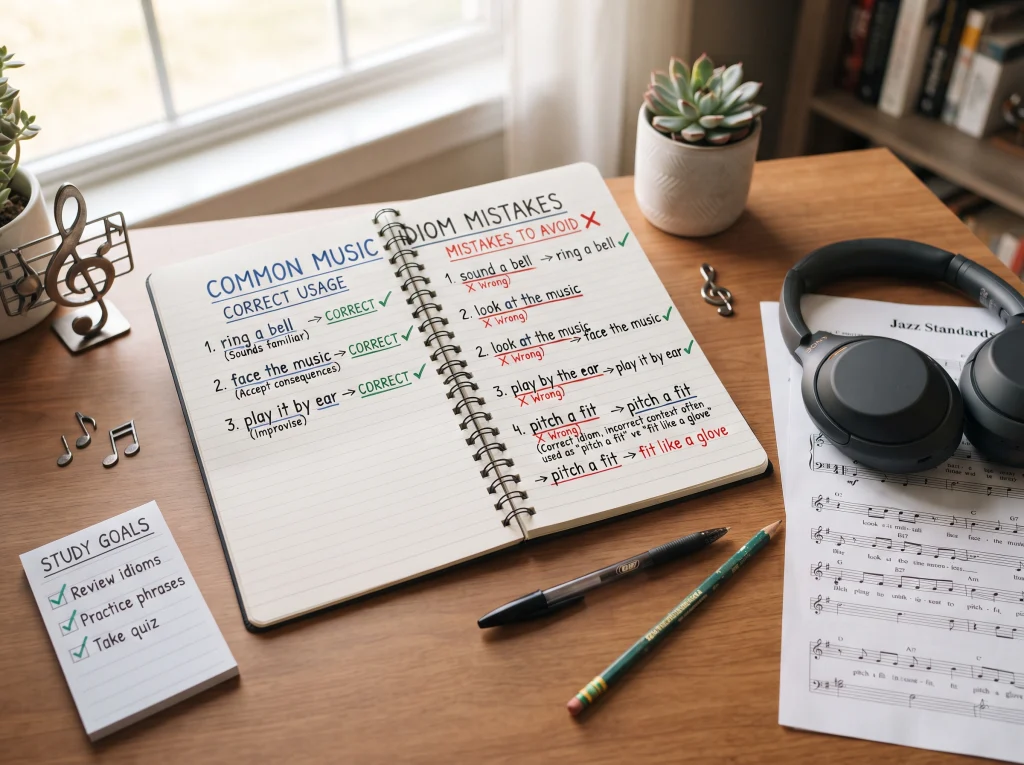
Common Mistakes to Avoid When Using Music Idioms
Even familiar idioms can be confusing when their wording or tone is misunderstood.
Taking the phrase literally: “Face the music” usually means accepting consequences, not standing in front of a band.
Changing established wording: Learn expressions in their conventional form. For example, “play second fiddle” is the familiar expression for having a subordinate role.
Ignoring context: “Blow your own horn” means bragging, so it may sound critical rather than complimentary.
Using an informal expression in a formal setting: “All that jazz” may suit a casual conversation but can sound out of place in a formal report.
Confusing similar expressions: “Play it by ear” means respond as events develop, while “play by ear” can refer to performing music without written notation. Context helps distinguish the meanings.
Assuming every phrase is equally common in the United States: Some expressions are more strongly associated with British English. When speaking to an American audience, familiar alternatives such as “blow your own horn” may be more suitable than “blow your own trumpet.”
Why Learning Music Idioms Is Helpful
Music idioms provide a useful way to expand vocabulary and recognize figurative language. They help learners understand expressions that appear in conversations, books, entertainment, and workplace communication.
Learning these phrases can help you:
- Understand the intended meaning of nonliteral expressions.
- Recognize familiar patterns in spoken and written English.
- Describe emotions, decisions, problems, and achievements more expressively.
- Improve reading comprehension by interpreting phrases in context.
- Communicate more naturally when an idiom fits the audience and situation.
Music-related expressions also offer a memorable way to connect vocabulary with familiar ideas such as rhythm, instruments, songs, and performances. Learning them in complete sentences gives you a practical foundation for recognizing and using them correctly.
Shop Idioms: https://learnidioms.com/shop-idioms/
FAQS
Conclusion
Music phrases and idioms bring expressive language into everyday English. Expressions such as “face the music,” “strike a chord,” “play it by ear,” and “end on a high note” allow speakers to communicate ideas in a memorable way, even when the subject has nothing to do with music.
The most useful approach is to learn each expression with its meaning, grammatical pattern, and a natural example. Practice a few at a time in conversations and writing, and pay attention to how American English speakers use them. With regular exposure, these phrases can become easier to recognize and use appropriately.






3 Comments